

Thanks to Michael Monahan (Doktor Goulfinger) for the above ads from Nightmare, San Francisco's Shock showings.

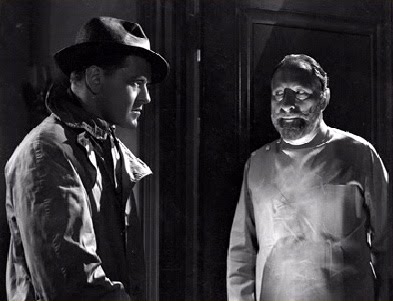
 The "white room" of the title is the operating room where Dr. Finley Morton is stabbed in the back with a scalpel during surgery on a rich society woman. By the time the operation is over, hard-boiled big city police Sergeant MacIntosh Spencer has arrived and is untangling the various relationships of the doctors and nurses in the operating room in order to find a motive. It is the usual soap opera-- some of doctors and nurses are romantically involved with one another; two rival doctors are competing for the big promotion that Morton is helping to decide; there are senior medicos with a complicated professional relationship involving medical ethics, jealousy, and a five year-old botched surgery; and there's even a skulking senior medical staff superintendent thrown in for good measure. One of the most likely suspects is the dashing Dr. Bob Clayton (Bruce Cabot), but he confounds Sgt. Spencer by trying to solve the case on his own with the help of his lover, Nurse Carole Dale (Helen Mack). There is also an irritating comedy relief couple consisting of a meddlesome half-witted ambulance attendant (Tom Dugan) and a braying, grating nurse (Mabel Todd), but the less said about these two, the better.
 The Daily Times-News, Burlington NC, October 28, 1939, seven months after MYSTERY OF THE WHITE ROOM was released theatrically

 But none of these almost-horror tweaks is enough to make MYSTERY OF THE WHITE ROOM into anything other than a B-movie murder-mystery of the 1930s. The cast is interesting one that connects MYSTERY OF THE WHITE ROOM to KING OF THE ZOMBIES, KING KONG, SON OF KONG, MYSTERY OF THE WAX MUSEUM, DR. X, HOUSE OF FEAR, MARK OF THE VAMPIRE, GHOST OF FRANKENSTEIN, THE MUMMY'S CURSE, MAN MADE MONSTER, VALLEY OF THE ZOMBIES, and some of other things, but there's really not a whiff of horror to be had despite the best efforts of some TV horror hosts over the years.
 San Antonio [TX] Express, May 2, 1958
 Daily Review Hayward, CA, April 9, 1960
 The Capital, Annapolis, MD, December 22, 1973

 Monroe College sociology professor Norman Reed (Lon Chaney, Jr.) is jinxed. A "mental giant" and a rising star, Reed has just returned from a jaunt somewhere in the tropical isles of the South Seas; he has brought back with him new research for a groundbreaking study on religion called Superstition vs. Science and Fact and a new wife, a lovely woman-child native priestess named Paula (Anne Gwynne). He seemed to be on the fast-track to becoming department chair, but that's when things spiraled out of control: his colleague Professor Millard Sawtelle (Ralph Morgan) shot himself to avoid a possible plagiarism scandal; Sawtelle's Lady Macbethian wife Evelyn (Elizabeth Russell) accuses Reed and his "witch" of engineering the scandal; and nasty rumors that Reed "has taken advantage of" his pretty undergraduate research assistant (Lois Collier, who may have been recognized by some SHOCK! viewers for her recurring appearances between 1951 and 1953 on Ziv's "Boston Blackie" TV show) dog him all over campus-- in fact, Reed is said to have beaten up his assistant's boyfriend when the latter tried to defend her honor. Then, while Paula continues to be the target of terrorizing harassment by Reed's bitter ex-lover Ilona (Evelyn Ankers), there is shooting on campus and the blame falls on Reed.
 Ad for KUTV-Channel 2's "Shock Theater" with horror-host Roderick in Salt Lake [UT] Tribune, February 27, 1960. COUNTER-ESPIONAGE (1942) was one of the "Lone Wolf" mystery-thrillers
 San Antonio [TX] Light, June 6, 1957. What a Universal horror drive-in line-up! WEIRD WOMAN (the typo that pluralizes the title is actually more accurate considering what happens in the movie) is shown here on Monday night with NIGHT MONSTER.
 The Daily Republic, Mitchell, SD, February 24, 1961
 Ordinarily, watching WEIRD WOMAN elicits a few harsh hoots of derisive laughter from me, but I made a very conscientious effort to watch it in good faith this time for the SHOCK! Viewing Project. Lon Chaney, Jr. still seems miscast as the brilliant and desirable intellectual, and his acting cannot keep up with the work done here by Gwynne, Ankers, and Russell, but I wanted to avoid thinking about that and just try to focus on the persistence of supernatural elements in an effort to recreate the horror-movie-on-TV experience as best as I could. And I feel that I largely succeeded-- I think that I could see WEIRD WOMAN's horror movie appeal for the first time.
 A big stumbling block for me, though, was the handling of the dance and prayer ceremony on Paula's island. In Drums o' Terror: Voodoo in the Cinema (1998), Bryan Senn describes this more as "a genteel luau" than a "frenzied rite": "Though Paula ominously labels it the 'Dance of Death,' sarong-wearing native girls pathetically stomp their feet and clap and wave their hands in an innocuously choreographed motion, making this weird pagan ritual look like low-rent nightclub filler." I have to wonder if the ceremony could have had a more disturbing edge in the hands of a director other than Reginald LeBorg (John Fulton's shooting star that crosses the sky at the climax of the Dance of Death looked good, though).
 The Dunkirk Evening Observer, Dunkirk-Fredonia, NY, January 14, 1958
 There is no monster, nor is there any supernatural or paranormal menace. But there are two very sinister humans-- one who murders and mutilates beyond recognition the faces of two women; another who is a greedy, amoral sociopath whose disembodied brain (stolen from the Paris morgue in the middle of the night) is ruled as pathological by an examining criminologist. And there's also a ton of nighttime gothic gaslight atmosphere that makes the movie interesting to look at (even though it's not that great to watch). So while there are others who will complain that THE MYSTERY OF MARIE ROGET is just a murder-mystery that has gotten a lot of hot-air horror-film hype over the years, I'm going to say that it is a very minor Universal horror film that would satisfy those viewers who can tolerate a weird mystery or two every once in a while in their monster-movie diet.
 Paris, 1889: Hot-ticket Comédie-Française warbler Marie Roget (Maria Montez) has been missing for a week and half, prompting all of Paris (it seems) into speculation that she's either run off with one of her lovers or fallen victim to foul play. Minister of Naval Affairs Henri Beauvais (John Litel), an intimate friend of the Roget family (especially of Marie's, it turns out), pressures Prefect of Police Gobelin (Lloyd Corrigan) to solve the case. Gobelin calls on his pal, police forensic chemist Dr Paul Dupin (Patric Knowles), for help. Dupin is famous for having solved the ghastly Rue Morgue murders some years back, and he agrees to help out just as word comes that a horribly disfigured corpse of a young woman has been dragged out of the Seine.
 San Mateo[CA] Times, August 16, 1958
 Gazette-Mail, Charleston, WV, May4, 1958

 One of the many mysterious nocturnal comings and goings in the garden during Du Lac's party
  Lots of coaches zipping through the wet, cobble-stoned streets of Universal's European village set
 The cloaked killer escaping across the Paris rooftops in the dead of night
 Realart Pictures followed Universal's lead when it re-released THE MYSTERY OF MARIE ROGET in 1951. They refer to the killer as "the Phantom Mangler" in the promotional materials (the name sounds like a foe in an El Santo movie), re-titled the film PHANTOM OF PARIS, and sent it back out to theaters as part of a double-feature with WEREWOLF OF LONDON.
 Charleston [WV] Daily Mail, February 13, 1952
 How many horror-movie fans have actually seen this on commercial-broadcast TV? I pose this question because I was surprised to see just how infrequently THE MAD DOCTOR OF MARKET STREET was shown in the usual "Shock Theatre/Creature Feature"-style time slots. In fact, it turned up more in the late afternoon and early evening, sometimes as part of of showcases with unintentionally amusing titles like "Hollywood's Best" and "Million Dollar Movie" (this movie is a long way from meeting either of those descriptors). Perhaps one reason for its appearance in those other programming niches is that it plays more like a tropical island adventure tale-comedy-romance than it does a horror melodrama.
 Gazette-Mail, Charleston,WV, November 22, 1959
 I also like small parts of THE MAD DOCTOR OF MARKET STREET because I'm a fan of director Joseph H. Lewis; as in a previous SHOCK! offering THE SPY RING, Lewis manages to smuggle in some cinematic style and atmosphere despite the microscopic budget and two-week shooting schedule. (One bit of business that's overdone, though, are the scenes where Atwill delivers anesthetic to his patients by advancing into the camera and smothering the lens with ether-soaked items-- Lewis does this three times in 61 minutes).
 "PSSST!! PSSST!! PA-TRICCCCC-IA!!"
 THE MAD DOCTOR OF MARKET STREET drinking game: take a shot of liquor every time that Nat Pendleton rolls his tongue along the inside of his cheeks like he's doing in this still. But beware the "weenie roast" scene!
 It's difficult for me to imagine how any SHOCK! fan who tuned in to watch MURDERS IN THE RUE MORGUE on television in 1957-58 could not have been swept up by this movie. How could SHOCK! watchers who had fallen for FRANKENSTEIN, DRACULA, and THE MUMMY not take to MURDERS IN THE RUE MORGUE? Yet, oddly enough, it is a film that not a lot of people mention as among their favorites of Uni's golden age of horror. "Though flawed and creaky, MURDERS IN THE RUE MORGUE is very likely the most underrated of Universal Horrors," Tom Weaver, Michael Brunas, and John Brunas write in the 2007 edition of their Universal Horrors: The Studio's Classic Films, 1931-1946. "Beyond its vulgar excesses and insipid theatrics lurks a daring, full-throttled, Poe-inspired thriller couched in a darkly sinister aesthetic all its own."
 To my eyes, MURDERS IN THE RUE MORGUE is a darkly twisted and wildly subversive horror film. Although occasionally it does get bogged down in what seems to be some of the old-fashioned visual grammar of silent film-making, I think that, in terms of radiating a sense of out-and-out pre-Code unclean weirdness, this movie is second only to THE BLACK CAT. Anyone unsuspectingly stumbling upon it on TV in the late '50s just had to have been unnerved by it.
 Salina [KS] Journal, April 25, 1958
 Another aggravation for many is the dispelling of Erik the Ape's monstrousness through the use of actual chimpanzee close-ups (some of which reminded me of shots in THE UNHOLY THREE [1925]). Erik is hailed as the "gorilla with a human brain," and there's something missing-link-y about him as he is presented in the sideshow by Dr. Mirakle (I really enjoy Lugosi's lecture in this movie). Charles Gemora was the guy in the shaggy gorilla suit; Gemora is legendary for his performances, yet someone on the film's production staff decided to toss out his very expressive facial close-ups as Erik in favor of chimpanzee footage which really breaks the spell, I think.
 And what in the name of the Hays Production Code is Mirakle up to? The movie description that I posted above suggests that Mirakle wants to create "an ape-woman," but what Mirakle actually says is that he wants to prove to his pre-Darwinian Parisian audience that human beings evolved from apes by "mixing blood" between a human and Erik. His "great experiment" (carried out in a fantastically Caligarian old deserted house in the Rue Morgue) so far has involved injecting Erik's blood into at least three women (presumably sex-workers whose syphilitic "dirty blood" compromises his experiment).
 Finally, Mirakle hits upon the idea of kidnapping a virgin in order to avoid contamination by venereal disease, but he doesn't count on the fact that Erik has fallen in love with Camille; Erik attacks Mirakle during the course of the experiment because he has already seen what happens to the women subjected to Mirakle's transfusions and he doesn't want this happening to her. So Erik kills Mirakle and makes off with her across the rooftops of Paris like a mid-nineteenth century Kong. What is Erik's plan for Camille if he ever eludes the crowd that is chasing him? Is this-- like so many apesploitation movies like INGAGI (1931)--suggesting the threat of bestial rape?
 detail from Emmanuel Frémiet's 1887 sculpture; an earlier version was displayed in Paris in 1859
 One last point about this film as it relates to SHOCK! requires us to look at the cover art of the Screen Gems promotional book. The painting used for the cover illustration is not a terribly good work, but it is certainly evocative of the horror film programming that Screen Gems was selling. Uni-holics will have no trouble matching the figures here with the movies despite the sometimes just-off caricatures. One of the things that surprises me about the rogues' gallery here on the cover is the inclusion of the troglodytic Janos the Black One (Noble Johnson in whiteface, of all things) and Erik from MURDERS IN THE RUE MORGUE.
 I don't know if there was a source for Erik's image, but it would appear that Janos' simian-like posture is lifted directly from this production still.

 Posts
All Comments
Posts
All Comments


